.png)


Employee Turnover Creates More Than Staffing Problems, It Creates Operational Chaos

Most practice owners think turnover is simply part of running a medical office. And to a certain extent, that’s true. Healthcare has faced staffing challenges for years. But from a financial and operational perspective, excessive turnover can quietly create an enormous amount of hidden work and expense throughout an entire practice.
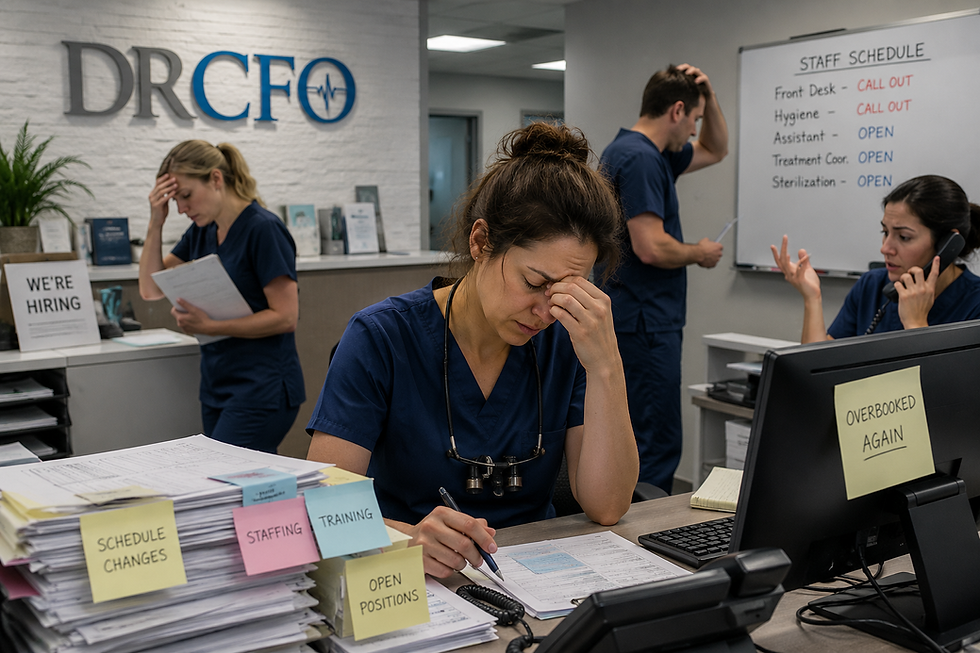
At Doctors CFO, we recently reviewed a practice that averaged only around 14 active employees at any given time. On the surface, it appeared to be a relatively stable small office.
But during the year, nearly 20 employees had cycled through the practice.
That meant the office was constantly:
onboarding new employees
rebuilding schedules
retraining staff
ordering new scrubs and uniforms
setting up payroll and benefits
creating and removing EMR access
and managing operational disruptions
The hidden operational cost became enormous.
Every new employee required:
onboarding paperwork
payroll setup
compliance training
EMR access
scheduling adjustments
benefit enrollment
credentialing
training time from existing staff
Then, only a few months later, the process often started all over again.
The practice repeatedly purchased:
scrubs
jackets
name tags
onboarding materials
workstation setups
while managers and experienced employees spent hours:
interviewing candidates
training replacements
correcting mistakes
adjusting schedules
and helping new hires learn systems and workflows
Meanwhile, experienced employees became increasingly frustrated and burned out from constantly training new team members. Patient experience also began suffering because newer employees were still learning:
workflows
communication standards
scheduling procedures
insurance processes
and office expectations
Over time, productivity quietly declined because the office was operating in a near-constant state of transition. The owner initially believed the turnover was simply part of healthcare staffing challenges. And to be fair, every medical practice experiences some level of turnover.
But when turnover becomes consistently elevated year after year, it may be worth looking deeper at the operational side of the practice.
Sometimes the issue is compensation. Sometimes it’s workflow inefficiency. Sometimes it’s communication or onboarding. Sometimes leadership stress unintentionally creates instability within the office.
And sometimes practices truly have just experienced a difficult stretch of hiring challenges.
The important thing is identifying the root cause rather than assuming turnover is “just normal.”
Because persistent turnover affects far more than staffing levels alone. It impacts:
profitability
productivity
payroll and administrative workload
overtime costs
training time
employee morale
patient experience
operational efficiency
collections
compliance
and long-term practice stability
Is Your Employee Turnover Normal?
At Doctors CFO, one of the many operational metrics Carl analyzes inside a practice is employee turnover. Because turnover numbers alone don’t always tell the full story. Some practices may simply experience a difficult hiring environment or temporary staffing challenges.
But in other cases, elevated turnover can point to operational inefficiencies that are quietly affecting profitability, staff morale, and long-term stability.
That’s why Carl takes a deeper look at questions like:
Is turnover higher than industry norms?
Are employees leaving shortly after being hired?
Are certain departments struggling more than others?
Are workflows creating unnecessary stress?
Is onboarding organized and consistent?
Are leadership and communication supporting long-term retention?
The goal isn’t to assign blame. The goal is to identify patterns, reduce operational stress, and build a more stable, profitable practice.
Practices with:
organized onboarding
consistent workflows
strong communication
stable leadership
and clear operational systems
often experience dramatically lower turnover and stronger long-term performance.
At Doctors CFO, we help medical and dental practices identify operational inefficiencies, improve financial performance, and build healthier, more stable organizations from the inside out.


Comments